

 Trusted by over 5,000 patients in more than 30 countries



How Does the Recovery Process Proceed After Breast Aesthetics?
The answer to how the recovery process proceeds after breast aesthetics can be summarized as a planned period, shaped by the individual’s general health condition, the scope of the technique applied, and the tissue structure, during which the body adapts to its new state following the surgical intervention, and physician guidelines are followed step by step. This process, in which the body’s tissue repair mechanisms come into play, refers to a timeline that varies according to each individual’s own biological pace, yet is based on certain fixed medical stages.
The anatomical reconstruction of the body following aesthetic surgical procedures is a matter that requires time and patience. After the medical steps carried out in the operating room, the real journey begins during the recovery period at home. The body enters a period of intense cellular activity in order to repair the surgical incisions made, nourish the relocated tissues, and reorganize the lymphatic system. At this stage, the individual is expected to listen to their own body, avoid rushing, and adhere to the lifestyle adjustments recommended by the physician. The oxygenation of cells, the regular flow of blood, and the regaining of tissue elasticity are all part of a biological cycle that spans several months.
As is frequently noted in analyses written by Buşra Nur Özger, who conducts detailed research in the field of digital health communication and medical informational content production, a correct psychological balance must be established between individuals’ pre-operative expectations and the post-operative adaptation period they experience. The recovery period is not merely a physical repair process, but also a multifaceted stage in which the individual mentally adjusts to their changing body form. In this context, knowing that each symptom is a normal biological reaction plays a major role in reducing anxiety about the healing process.
What Can Be Expected on the First Day After Breast Aesthetics?
The answer to what can be expected on the first day after breast aesthetics is: a stationary initial phase during which the effect of anesthesia gradually leaves the body, the patient rests in the hospital under medical supervision, fluid support is provided via IV, and movements are kept limited in order to protect the tissues.
When the patient is transferred from the operating room to their hospital room, the body’s hemodynamic balance is closely monitored by nurses and physicians. The aim is to keep basic vital signs such as blood pressure, pulse, and body temperature within their normal range. During the stage in which anesthetic substances are cleared from the metabolism, it is natural to experience mild dizziness, nausea, or a feeling of chill; these reactions are easily eased with intravenous medications administered by the medical team. The patient’s bed position is usually adjusted so that the upper body is kept slightly elevated. This lightens the feeling of pressure that could otherwise be created by blood flow toward the head and chest area due to the effect of gravity. In these first hours, instead of standing up or walking, the goal is simply to keep the lungs’ capacity open by performing deep-breathing exercises.
How Does the Hospital Discharge Stage Take Place?
The question of how the hospital discharge stage takes place is answered as follows: it is defined as the process in which, following the final clinical checks performed by the physician after the first twenty-four or forty-eight hours after the operation, the patient’s vital signs are found to be stable, and home care instructions are conveyed to the patient along with a prescription.
In order for the discharge decision to be made, the body is expected to be able to consume fluids independently, tolerate simple activities around the house, and the applied medical bandages are expected to be in their normal appearance. If medical drains were placed during the operation to carry fluid accumulation out from under the skin, the amount of fluid coming from these drains is checked. Physicians explain in detail the dosage of the medications to be used at home, how the dressings should be maintained, and under what circumstances the doctor should be contacted urgently. It is recommended that the patient not drive the vehicle themselves on the way home, and that they travel in a comfortable position while avoiding jolts.
What Should Be Considered During the Resting Period at Home After Breast Aesthetics?
The answer to what should be considered during the resting period at home after breast aesthetics is a set of precautions in which the arms are not strained, heavy objects are not lifted, prescribed medications are used regularly, and the sleep positions determined by the doctor are adhered to, all supporting the body’s own self-repair process.
Upon returning home, the first few days should be devoted to rest, but this does not mean lying motionless in bed the entire time. In order to keep blood circulation active and reduce the risk of clot formation in the vessels, it is recommended to take short, slow-paced walks around the house. Movements that directly strain the chest muscles (pectoral muscles), such as raising the arms above head level, pushing heavy doors, or reaching for high shelves, should be avoided for a while. Clothing choice is also an important part of this period; wearing loose, cotton garments that button or zip in the front and do not require raising the arms overhead will increase personal comfort.
Why Is the Use of a Medical Bra Considered Necessary After the Operation?
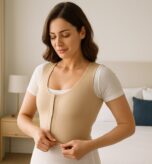
The answer to why the use of a medical bra is considered necessary after the operation is that it provides medical support that helps the tissues stay fixed in their new position, helps disperse localized swelling, and lightens the physical load on the wound areas by reducing the adverse effects of gravity.
These underwire-free and seamless compression garments, produced from specially woven fabrics, act as an external mold for the breast’s reshaping anatomy. Just as a broken bone must remain motionless in a cast to heal, it is essential that the placed implants or the regathered breast tissue be held in a fixed position so that they can bond with the subcutaneous ligaments. These bras also apply light, even pressure to the skin, supporting lymphatic flow, which reduces fluid accumulation between tissues. Wearing them continuously, day and night, for the period determined by the doctor (usually a few weeks) is a factor that supports the speed at which the body adapts to its new form.
How Does Diet Contribute to the Recovery Process?
The question of how diet contributes to the recovery process is answered as follows: it is a biological support mechanism that helps accelerate cellular renewal through the consumption of proteins that support cell repair, vitamins that boost the body’s resistance, and low-sodium foods that limit increased swelling.
In order to counter the physical stress that surgery creates in the body, the metabolism needs extra energy and building blocks. A dietary plan rich in vitamin C and zinc should be established so that the collagen fibers that provide tissue integrity can be synthesized. At the same time, limiting sodium (salt) consumption prevents the body from retaining unnecessary water, allowing swelling to subside more quickly. Adding fiber-rich foods to the diet is important for digestive comfort, so that bowel movements do not become sluggish.
| Food Category | Main Function in the Body | Recommended Sources |
|---|---|---|
| High-Quality Proteins | Muscle repair, wound healing, and cellular renewal | Boiled eggs, grilled fish, lentils, chickpeas, yogurt |
| Antioxidants and Vitamins (C, A) | Boosting collagen synthesis, strengthening infection resistance | Spinach, broccoli, orange, kiwi, sweet potato, carrot |
| Healthy Fats (Omega-3) | Cell-membrane elasticity, suppressing internal inflammation | Walnuts, chia seeds, olive oil, salmon, avocado |
| Complex Carbohydrates and Fiber | Providing steady energy, regulating the digestive system | Oatmeal, whole-wheat products, fresh vegetables, pear |
When Does the Return to Physical Activities Begin?
The answer to when the return to physical activities begins is: a planned medical timeline in which only short walks around the house are allowed in the first weeks, followed in subsequent months by a gradual, doctor-supervised transition to aerobic movements and, later, muscle-strengthening exercises.
Increasing activity capacity should be done without tiring the body, respecting the healing phases of the tissue. Sports that excessively raise the heart rate and increase blood pressure can lead to leakage at the wound sites or unwanted complications in the early period. For training that places weight-bearing demands on the arms or makes intensive use of the chest muscles (such as push-ups or pull-ups), it is necessary to wait for the later weeks, after the physician has confirmed that the tissue has healed. Returning to sports gradually, by listening to the signals the body gives, is a major step toward the healthy progress of the process.
| Recovery Timeline | Recommended Activities | Movements to Avoid |
|---|---|---|
| Weeks 1–2 | Light walking around the house, seated stretches (excluding the arms) | Lifting weights, reaching for high shelves with the arms, doing housework |
| Weeks 3–4 | Brisk walking outdoors, using a stationary bike (lower body) | Running, cardio movements involving jumping, swimming |
| Weeks 5–6 | Light-paced jogging, lower-body weight training | Chest press, push-ups, strenuous racquet sports |
| Week 8 and Beyond | Swimming, fitness, pilates, and general training with doctor’s approval | Professional competitions that push the body excessively without medical supervision |
How Are the Sutures and Wound Care Managed?
The question of how the sutures and wound care are managed is answered as follows: it is a delicate routine in which usually self-dissolving suture materials are used, requiring no external intervention, and the area is kept clean and moist through dressing only with the solutions or medical products recommended by the physician.
Protecting the surgical incision points from the external environment is the primary task in terms of preventing microbial agents from entering. In current aesthetic surgery practice, sutures that can be biologically absorbed by the body are frequently preferred. This keeps the patient free from the stress of having stitches removed. Special medical tapes applied over the incision areas bring the edges of the wound closer together, laying the groundwork for it to heal as a thin line. The patient not trying to remove these tapes on their own, not picking at areas that have scabbed over, and regularly using the scar-care gels indicated by the physician are factors that directly affect the final appearance of the scars.
When Do Swelling and Edema Decrease After Breast Aesthetics?
The answer to when swelling and edema decrease after breast aesthetics is a biological timeline in which the swelling, which peaks within the first three days, gradually decreases over the following weeks as the body’s lymphatic system does its work, and the tissue reaches its final softness within a few months.
Every tissue that undergoes a surgical procedure reacts with localized fluid accumulation as a defense and repair mechanism against trauma. This condition, called edema, is an essential biological response for transporting repair cells to the tissues. The main reason the breasts feel larger, tighter, and firmer than intended in the days following the operation is this increase in lymphatic fluid. Starting from the third week, this feeling of tightness begins to noticeably decrease, the skin stretches, and the tissues soften. The process of the breast reaching its final form, with the edema largely eliminated and the tissue forming a natural downward curve, can span a period of approximately six months to a year.
What Should the Sleeping Position Be?
The answer to what the sleeping position should be is a special resting arrangement in which, in order to avoid applying pressure to the chest area, the patient lies on their back with the head kept elevated using several pillows in the first weeks, avoiding face-down or side-lying positions.
Sleep posture is one of the major factors affecting the quality of recovery. Lying face-down causes the body’s weight to press directly onto tissues that have undergone surgery, which can strain the suture lines and disrupt local blood flow. Lying on one’s side, on the other hand, can cause the implant pocket to expand or the breasts to be exposed to asymmetric pressure, particularly in patients with implants. Lying on the back with the head elevated helps swelling in the upper body drain more easily toward the lymphatic channels with the assistance of gravity, and also makes breathing easier. Placing support pillows on both sides of the bed to limit involuntary turning to the sides is often recommended as a practical precaution.
When Can the Bathing Routine Resume?
The question of when the bathing routine can resume is answered as follows: depending on the condition of the tapes at the operation site and the surgical technique applied, it generally begins on the third or fourth day, after the doctor’s approval, with brief showers taken with lukewarm water and without rubbing the area.
Contact between water and the wound areas should be postponed until the incision sites have closed sufficiently and the epithelialization process (formation of new skin cells) has begun. In the first permitted showers, avoiding extremely hot or extremely cold water and preferring a lukewarm water temperature is important for skin sensitivity. It is recommended that the water stream not be directed straight at the chest area, and that soap or shampoo suds simply be allowed to run off over it. During the drying stage after bathing, harsh movements (rubbing) with standard towels should be avoided; instead, moisture should be removed with gentle dabbing, or the area over the tapes can be dried using a hair dryer set to a cool-air setting.
How Does Psychological Adaptation Occur During the Recovery Process?
The answer to how psychological adaptation occurs during the recovery process is a mental acceptance stage that requires patience while adjusting to the physical change in the body, managed with the awareness that the temporary appearance initially caused by swelling and tapes will resolve over time.
The post-operative period is a process in which not only do the body’s physical boundaries change, but emotional fluctuations can also be experienced. The clearing of anesthesia from the metabolism, the use of pain medications, and physical restrictions can bring about a temporary change in mood, sometimes accompanied by mild sadness. The tapes, bruises, or tightness seen when first looking in the mirror do not reflect the final result. It can take weeks for the body image to be mentally updated. As also noted in medical recovery practices examined by Buşra Nur Özger, accepting that this period is a temporary biological phase helps place recovery expectations on a realistic footing and supports the patient’s inner peace of mind.
Why Should Follow-Up Appointments Not Be Skipped?
The answer to why follow-up appointments should not be skipped is that they form a medical monitoring schedule arranged so that the physician can directly observe the condition of the healing tissue, the healing process of the sutures, and the stage at which the breast is taking shape, allowing for early intervention in the event of possible medical issues.
Surgical success is proportional not only to the skill demonstrated on the operating table, but also to the professional follow-up afterward. Physician appointments scheduled at specific intervals, such as the first week, first month, third month, and first year, ensure that tissue integrity is evaluated to scientific standards. During these check-ups, the doctor examines the degree of softening in the breast by palpation (manual examination), assesses the progression of the scars, and provides personalized answers to the questions the individual wants to ask. Critical turning points, such as changing the bandages, ending the use of the medical bra, or starting scar creams, become clear only after passing through the physician’s physical examination.
When Can the Return to Work Be Planned?
The question of when the return to work can be planned is answered as follows: it is a stage that varies depending on whether the patient works a desk job or a job requiring physical exertion; for desk jobs, a rest period of about one to two weeks is generally considered sufficient, while for jobs requiring physical effort, a longer period is expected.
Integration into modern working life is directly related to the individual feeling physically and mentally ready. Individuals who work at a computer, performing their duties seated throughout the day, can adapt to the office environment relatively quickly. However, even during this process, it is recommended to avoid remaining motionless for long hours and to stand up at intervals to ease blood circulation. In occupational groups such as teaching, healthcare work, or those requiring physical activity in the field, the return-to-work date should be spread over a more flexible timeframe, together with a physician’s report, taking into account the potential for intensive use of the arms. Keeping stress levels under control at the workplace also indirectly has a positive effect on the speed of cellular healing.
Frequently Asked Questions
1. How long does it take to return to daily life after breast aesthetics?
The answer to how long it takes to return to daily life after breast aesthetics is that the stage at which the individual can perform their own self-care and meet their basic needs is generally reached within a few days to a week, an adaptation period during which social activities that do not tire the body can be resumed.
2. How should medication use be managed during the recovery period?
The answer to how medication use should be managed during the recovery period is that it is a systematic use in which the antibiotics prescribed by the surgeon are taken on schedule as a protective shield against infection risk, and appropriate pain relievers without blood-thinning properties are also taken on the doctor’s recommendation.
3. When does it become possible to lift heavy objects after the operation?
The question of when it becomes possible to lift heavy objects after the operation is answered as follows: in order to prevent straining the chest muscles, it is necessary to avoid lifting items over approximately five kilograms for the first four to six weeks, after which the weight restriction is eased according to the physician’s assessment.
4. How long should one wait before traveling?
The answer to how long one should wait before traveling is a medical timing according to which, in order to prevent pressure changes or prolonged immobility from creating complications, it is generally recommended that a period of a few days to a week pass before air travel.
5. How should the medical bra be selected?
The answer to how the medical bra should be selected is that clinical-standard products should be preferred that match the size and model recommended by the doctor — seamless, cotton, front-hook or front-zip — that do not irritate the skin but support the tissues by wrapping them snugly.
6. Is numbness experienced in the operated area?
The question of whether numbness is experienced in the operated area is explained as follows: the surgical incisions can temporarily affect superficial nerve endings, and experiencing numbness, tingling, or heightened sensitivity in the nipple or lower areas during the first weeks is a normal part of the biological repair process.
7. What products can be used for scar care?
The answer to what products can be used for scar care is the regular use, after the incision sites have closed and the doctor has given approval, of silicone-based gels, tapes, or re-epithelializing creams that strengthen the skin’s moisture barrier and help the scar tissue fade.
8. Is sunbathing risky during the recovery process?
The answer to whether sunbathing is risky during the recovery process is that exposing newly formed scars to ultraviolet (UV) rays can lead to permanent darkening of color (hyperpigmentation) in that area, which is why scars should be protected from direct sunlight for at least a year.
9. How does smoking after the operation affect healing?
The question of how smoking after the operation affects healing is detailed as follows: substances in tobacco products narrow the blood vessels, disrupting microcirculation, reducing the oxygen reaching the wound site, interrupting tissue repair, and increasing risks such as wound reopening.
10. Do massage applications support healing?
The answer to whether massage applications support healing is that, unless the doctor gives specific guidance depending on the model of implant placed or the procedure applied, pressure should not be applied to the area in the early period; in later months, manual manipulations appropriate to the doctor’s instructions may be performed to support capsule flexibility.
11. How long should one wait before wearing tight clothing?
The answer to how long one should wait before wearing tight clothing is that loose garments are preferred during the first weeks, when swelling is intense, in order to avoid applying unnecessary pressure to the tissue, and once the use of the medical bra has ended, a transition can be made to flexible clothing that does not squeeze the breast.
12. Is it appropriate to drink herbal teas that reduce swelling?
The question of whether it is appropriate to drink herbal teas that reduce swelling is answered as follows: due to the possibility that certain herbal mixtures may affect the blood-clotting balance or interact with prescribed medications, consuming such beverages in the first weeks after the operation without consulting the physician is not recommended.
13. When does raising the arms overhead become free again?
The answer to when raising the arms overhead becomes free again is that, in order to prevent straining the chest muscle and placing load on the suture lines, the arms should not be raised above shoulder level for the first ten to fifteen days, after which gentle stretching movements can gradually begin.
14. When can driving be resumed?
The answer to when driving can be resumed is that it is a matter evaluated with the doctor’s supervision after an average period of one to two weeks, once the reflexes are clear of anesthesia or medication and steering or gear-shifting movements no longer cause discomfort in the chest area.
15. When does it become possible to lie face-down during the recovery process?
The question of when it becomes possible to lie face-down during the recovery process is answered as follows: once the surgical area has lost its sensitivity and the time required for the implants or tissues to settle has elapsed, this generally becomes possible after the sixth month, with individual variation, and with the doctor’s positive assessment.